
Insights
What Southeast Asia's Digital Economy Means for Payments
Growth is arriving as more transactions, not bigger ones — and the economics of accepting them are being repriced around that
2026 · Insights
Southeast Asia's digital economy will pass $305 billion in gross merchandise value this year. Revenue will reach $100 billion. Both grew about 15%.
Those are the headlines from the tenth e-Conomy SEA report by Google, Temasek and Bain. The story underneath them matters more to anyone running payments.
Growth is coming from more transactions, not bigger ones. Those transactions are moving onto the cheapest rails available. Take rates are falling as a result. And the region is betting on AI to make the economics work — with more enthusiasm than anywhere else on earth, and a clear limit on where that enthusiasm stops.
1. Consumers are buying more often, not spending more
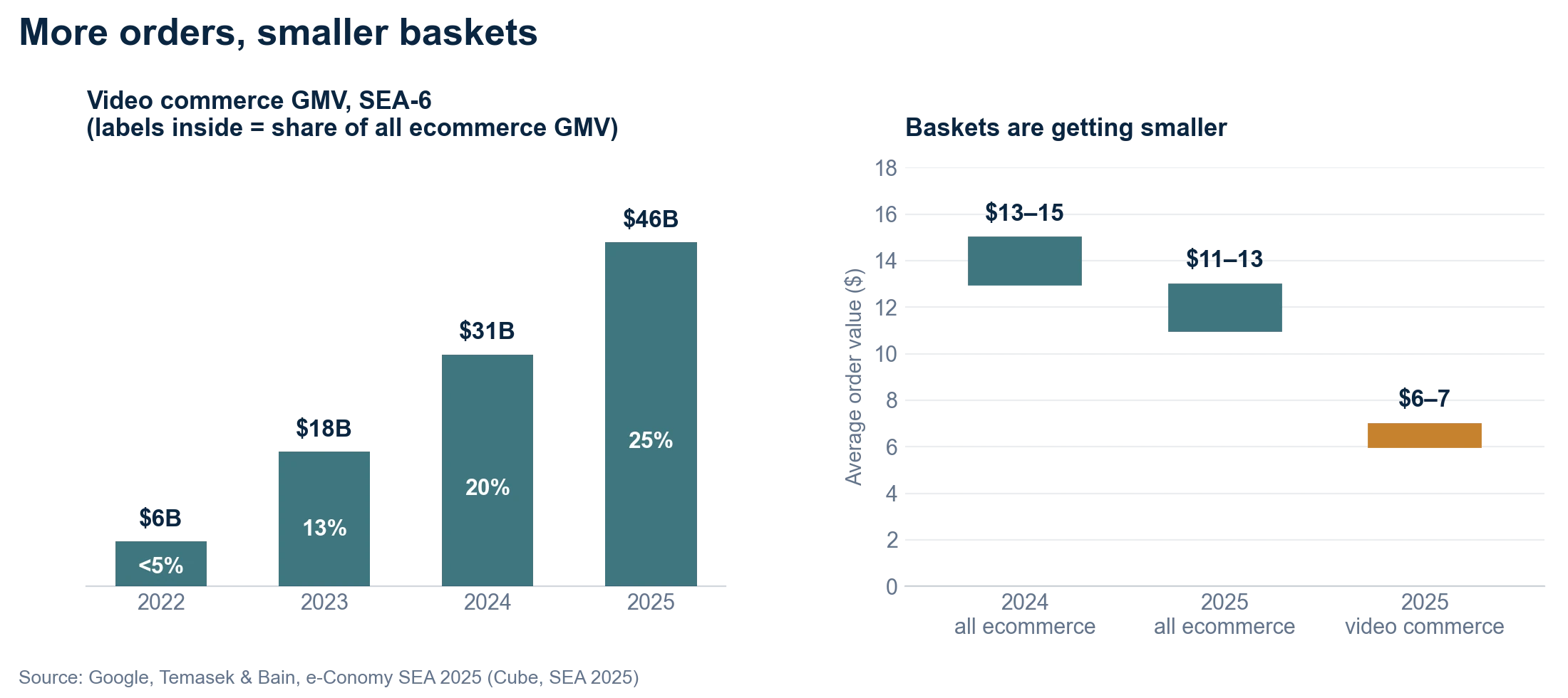
Video commerce — shopping through livestreams and short video — now drives 25% of all ecommerce GMV, up from under 5% in 2022. It hit roughly $46 billion this year, two and a half times its 2023 level.
Look at how it grew. Transaction volume rose 50% year on year, past 6.5 billion orders. The average video commerce order is worth $6 to $7. The average order across all ecommerce is $11 to $13 — down from $13 to $15 a year ago.
Video commerce is not making baskets bigger. It is making them smaller, far more frequent, and it is pulling the whole market average down with it.
The same pattern runs through the rest of the economy. Food delivery has shifted from occasional treat to routine purchase, with platforms deliberately adding cheaper menu options to widen the base; GMV grew 14% to $23 billion. Where value per transaction did rise, it was price, not appetite: online travel GMV grew 11% on airfares running at 115% of 2019 levels and hotel rates at 120–125%. Travellers are taking shorter trips, not more expensive ones.
What this means. When the average basket halves and volume doubles, per-transaction cost stops being a rounding error. Authorisation rates, failure handling and reconciliation load become the binding constraints. Any fee structured as a flat amount per transaction gets repriced by the market, whether you choose to reprice it or not.
There is real headroom underneath this. Consumer spending per person in the region is $3,400 a year, against $5,300 in China and $59,000 in the US. The digital economy is 7% of regional GDP, against 15% in mature markets. Volume arrives first. Value can follow.
2. QR and wallets took the volume. Cards kept the value.
Digital payments gross transaction value reached $1.41 trillion across ASEAN-10 this year, up 19%. Split it and the picture is stark.
Across the six largest markets, account-to-account and wallet payments grew from $552 billion to $917 billion in two years — about 29% a year. Cards went from $449 billion to $478 billion — about 3% a year. Account-to-account is compounding at roughly nine times the pace of cards.
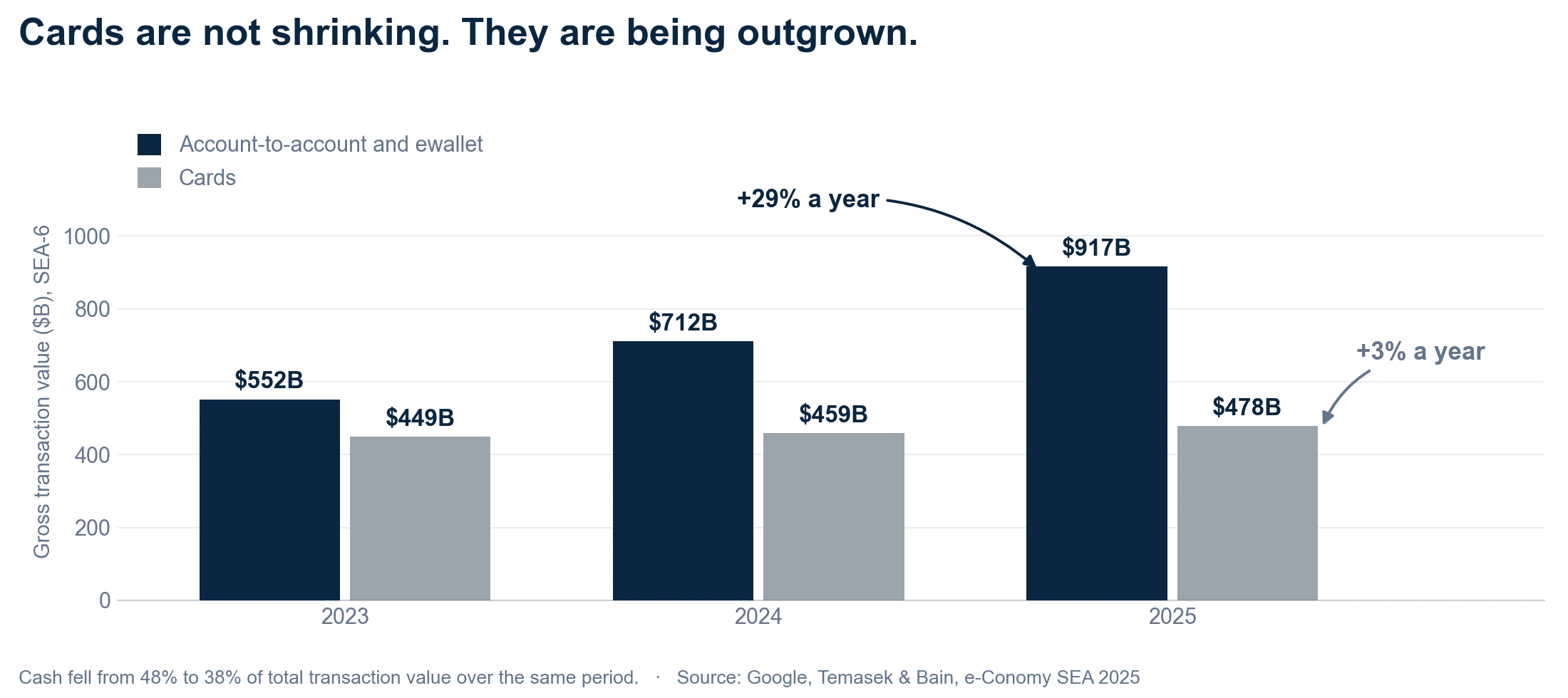
Cards held about 45% of digital payment value in 2023. Today they hold around 34%. Cards did not shrink. They were swamped.
Two forces did it. National QR is now universal — with Myanmar's MMQR and Brunei's tarusQR launching this year, all ten Southeast Asian markets have a national QR system. And those systems increasingly talk to each other: eight national QR schemes now interoperate across borders, and the Regional Payment Connectivity initiative added Cambodia this year for nine central bank signatories.
Cash is the casualty, down from 48% of total transaction value in 2023 to 38% today, heading for 27% by 2030.
Cards are not going away. Credit card retention stays high on entrenched habits and rewards. But the mix varies enormously by market — cards are 70–80% of payment value in Singapore and under 10% in Indonesia, Cambodia, Myanmar and Laos. There is no single regional card strategy.
Now the part nobody puts in a press release. Payments revenue across the six largest markets grew about 10% a year while transaction value grew closer to 18%. The blended take rate fell from roughly 0.71% to 0.61%. Merchant discount rates are declining by around 0.05 percentage points annually, and the report is blunt that any non-zero rate now comes with an expectation of value-added services attached.
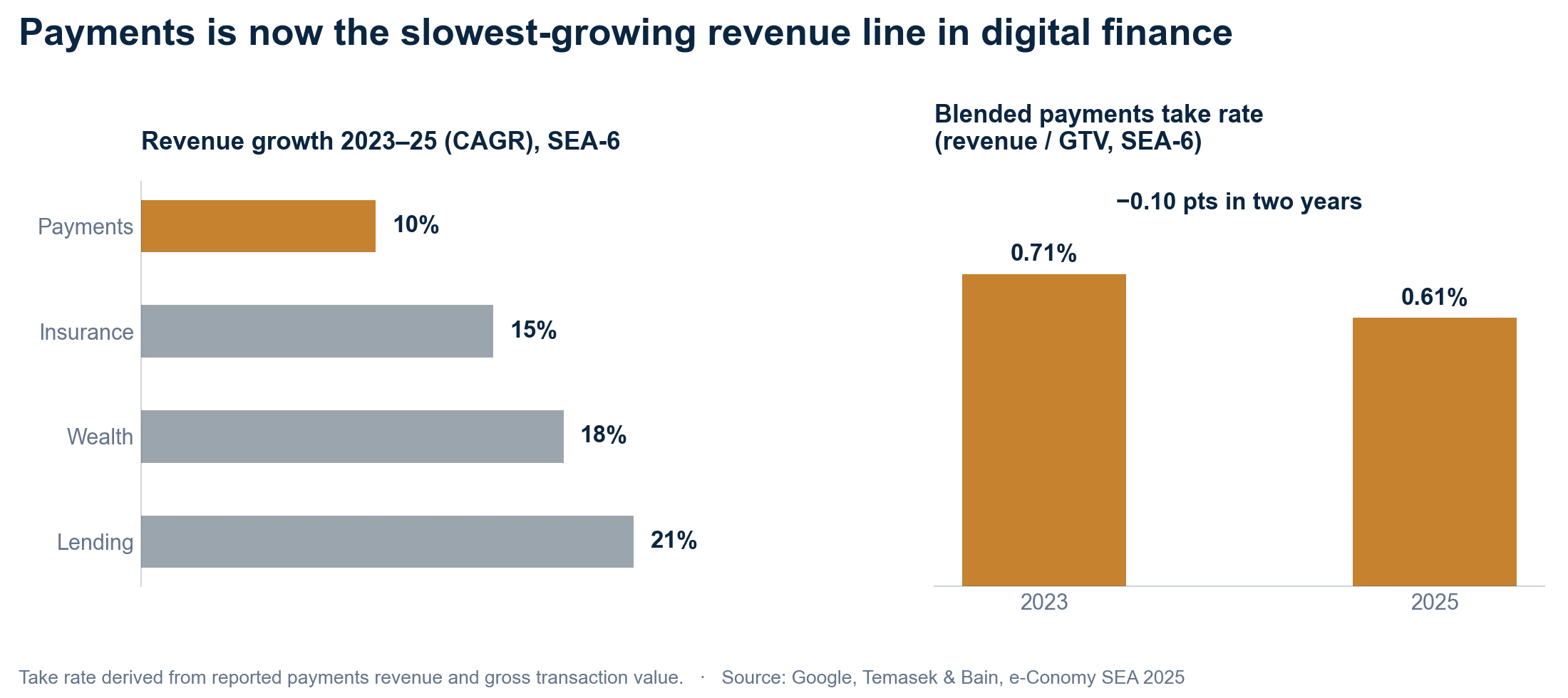
Payments is now the slowest-growing revenue line in digital financial services — 10%, against 21% for lending and 18% for wealth. That is not failure. That is what happens when a business becomes infrastructure. The margin moves to what you build on top of the rails.
One gap worth claiming. Global card networks are racing to enable AI agents that pay — Visa's Intelligent Commerce is built on 4.8 billion card credentials and 150 million merchant locations. Southeast Asia is not a card market. If agent-initiated payments land here, they run on wallets, QR and national digital ID. No global network will build that. Regional players have to.
3. The region wants AI. It does not trust it with money.
Southeast Asia's roughly 500 million internet users are 10% of the world's online population, and their appetite for AI is a genuine outlier.
Consumer interest in AI runs at three times the global average. Multimodal AI interest is 1.7 times higher, with five regional markets in the global top 20. Net positivity toward AI is 1.6 times the global average. 79% of workers say they have already learned to use AI. Generative AI course enrolment grew 5.2 times in Vietnam and 4.8 times in the Philippines in a single year.
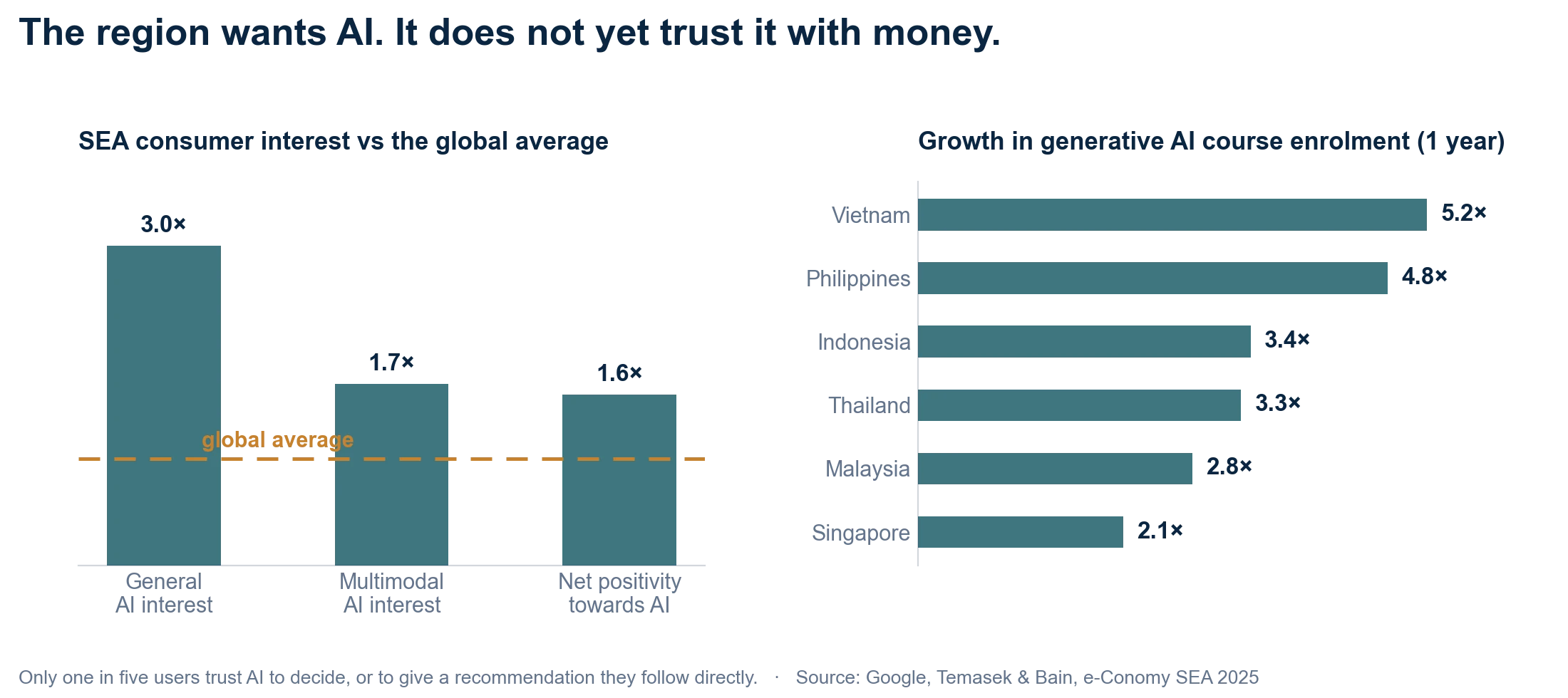
It is already moving money: 62% of consumers say AI features have influenced their purchase decisions.
Then the ceiling. Only one in five users trust AI to make the best decision, or to give a recommendation they follow directly. Three in five want human confirmation, or treat AI as one input among several. People will let AI find them a product. They will not let it move their money unsupervised.
There is a second constraint that does not exist in the West. Average wages in the region are 5% of US levels and 36% of China's. When labour is this cheap, automating a process to remove headcount often fails the business case outright. The wins here augment: DBS runs 1,500 AI models across 370+ use cases for a projected $1 billion in economic value this year; Grab's AI Driver Companion is used weekly by more than 250,000 drivers and lifts their daily earnings 10–20%.
Infrastructure is following. With 4,620 MW of planned data centre capacity, the region is set to grow around 180% against 120% for the rest of Asia Pacific, led by Malaysia at +350%. Yet Southeast Asia attracts only about 2% of global AI startup capital against a 4% share of global GDP. Interest is running well ahead of investment.
Six takeaways
- Design for frequency, not size. Baskets are shrinking while transaction counts surge. Per-transaction economics now decide whether the business works.
- Cards are being outgrown, not killed. Account-to-account compounds at nine times the card rate. Build a portfolio where cards hold value and QR carries volume — and accept that the mix in Singapore has nothing in common with Indonesia.
- Assume your take rate keeps falling. 0.71% to 0.61% in two years. Every basis point you keep now needs a service attached to it.
- The margin has moved up the stack. Payments grows at 10%; lending grows at 21%. Own the transaction, then monetise what the transaction data makes possible.
- Build agentic payments for wallets, not cards. Global standards are being built on card rails the region does not use. That gap is a regional opportunity, and it will not stay open long.
- Justify AI on effectiveness, not headcount. At 5% of US wages, labour substitution rarely clears the hurdle. And keep a human confirmation step wherever money moves — only one in five customers want it any other way.
Source: Google, Temasek and Bain, e-Conomy SEA 2025. Take rates and growth rates by payment instrument are derived from the report's reported values.