
Best Practices
Managing Chargebacks in Southeast Asia
Why the standard playbook only half-works here — and what merchants, acquirers and platforms should do instead
2026 · Best Practices
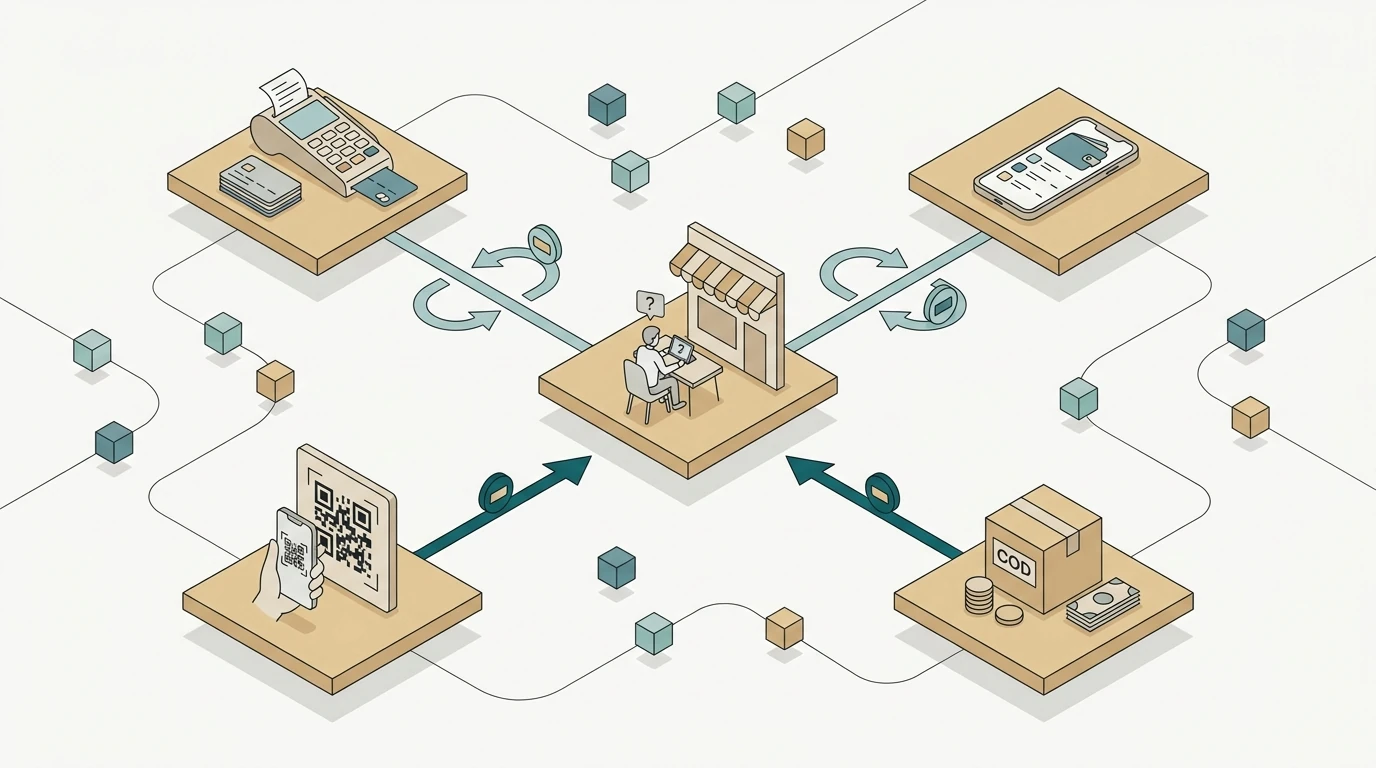
Disputes are no longer an exception to be handled by a back-office team. They have become a permanent cost line and, increasingly, a constraint on which merchants get to keep their acquiring relationships at all. The pressure is sharpest in this part of the world: Asia Pacific is seeing the fastest growth in chargeback value of any region, at roughly 35% annually, driven by the sheer pace of e-commerce expansion.
But most published guidance on chargeback management is written for card-first markets. Southeast Asia is not one. Applying that playbook without translation leaves merchants solving for the smallest part of their dispute exposure while ignoring the rails where they have no recourse at all.
First: know which rails actually give you a chargeback
Before designing a dispute strategy, map your payment mix against the recourse each method offers. In this region the answer differs dramatically by rail.
Cards carry the classic chargeback right: a defined reason-code framework, a representment window, and a ratio your acquirer monitors. This is where the conventional playbook applies — but in most Southeast Asian markets, cards are a minority of checkout volume.
E-wallets operate under platform-level dispute rules rather than network rules. Timelines, evidence standards and merchant appeal rights are set by the wallet operator and vary widely. Merchants routinely discover, after the fact, that a wallet provider's decision is effectively final.
Real-time bank transfers and QR — the rails that now dominate everyday commerce across the region's national schemes — are push payments. There is no chargeback mechanism. Funds move irrevocably. A customer who feels wronged has no dispute button; they have a complaint channel, a police report, or a regulator. This is the single most important structural difference from card-first markets, and it cuts both ways: merchants face far less dispute leakage on these rails, but their customers have far less protection, which makes trust, refund responsiveness and clear post-purchase communication a commercial necessity rather than a nicety.
Cash on delivery, still material in Indonesia, Vietnam and the Philippines, has no dispute construct either — but return-to-origin is its economic equivalent, and often a larger drain than card chargebacks ever were.
BNPL introduces a third-party lender into the dispute chain, with its own resolution rules layered on top of the underlying funding method.
The practical implication: a merchant whose card mix is 15% of volume should not spend 90% of its dispute budget on card tooling. Build the risk register by rail, then allocate.
1. Fix the operational root causes first
Before buying mitigation tooling, look inward. The overwhelming majority of disputes are symptoms of a business-model problem, and fixing those is both cheaper and permanent.
Compress fulfilment times. “Product not received” remains a leading dispute reason, and the region's cross-border commerce structure makes it worse: goods sourced from North Asia, cleared through customs, then handed to a last-mile network across an archipelago or a mountain range. Every additional week between order and delivery raises dispute probability. Regional warehousing, realistic delivery windows displayed at checkout, and proactive delay notifications do more for the dispute ratio than any representment tool.
Make the checkout disclosure unambiguous — and localised. Customers dispute what they do not recognise or did not expect. Two failure modes dominate here:
- Recurring billing consent. If a customer does not understand they are enrolling in a subscription, the second charge becomes a chargeback. Present the renewal price, frequency and cancellation path on the same screen as the payment button — not in linked terms — and send a pre-debit notification before each renewal.
- Descriptor recognition. Merchants selling into Southeast Asia through an offshore acquiring entity frequently push a foreign legal-entity name onto the statement or wallet transaction history. In a market where the customer bought in Bahasa, Thai or Vietnamese from a locally branded storefront, an unfamiliar Latin-script descriptor is a dispute waiting to happen. Descriptor localisation is one of the highest-return, lowest-effort fixes available.
The relevant compliance frame is local: consumer protection and fair-trading legislation, e-commerce and distance-selling rules, and central bank conduct expectations across Singapore, Malaysia, Indonesia, Thailand, the Philippines and Vietnam. These regimes are not uniform, and auto-renewal and refund-disclosure expectations in particular differ market by market. Build the checkout to the strictest standard in your footprint rather than maintaining six variants.
Give customers a resolution path before they reach their bank. A dispute filed with an issuer is a customer who could not reach you. In this region that means being present on the channels people actually use: in-app chat, messaging apps, and local-language support during local hours — not an English-only email queue on a foreign time zone. Same-day refund decisions on low-value orders are almost always cheaper than the fully loaded cost of a chargeback.
Manage reputation as a risk signal, not a marketing metric. Acquirers and PSPs assessing your risk do not look only at the raw ratio. They look at marketplace seller ratings, app store reviews, complaint volumes on social and live-commerce channels, and whether your name appears in regulator or consumer-association complaint data. A merchant with a 0.3% ratio and a visible trail of unresolved complaints will be underwritten more harshly than the numbers alone suggest.
2. Use technology for what leaks through
Pre-dispute alerts and rapid resolution. Issuer-linked alert networks notify a merchant that a dispute has been raised before it is recorded as a chargeback, allowing an immediate refund that resolves the case without it counting against the ratio. This works well — where issuers participate. Coverage across Southeast Asian issuers is materially thinner than in mature card markets and varies sharply by country. Ask your acquirer for actual issuer coverage rates in each market you sell into before pricing the benefit into your model; the same product can eliminate half your disputes in one market and 5% in the next.
Deflection and compelling evidence. Where a customer disputes a transaction they in fact authorised and used, merchants can contest without refunding by supplying prior transaction history, device and IP data, login records and delivery confirmation directly into the pre-dispute flow. This matters more each year: first-party fraud has become the most prevalent fraud type globally, rising to 36% of reported fraud in 2024 from 15% a year earlier. Merchants with persistent customer identity — accounts, app logins, repeat purchase history — win these cases. Guest-checkout merchants generally cannot.
Treat strong authentication as the primary control. This is where the region has an advantage worth using. OTP and 3-D Secure step-up are deeply embedded in consumer expectations across most Southeast Asian markets, and authenticated card transactions shift fraud liability to the issuer. Full-blast authentication on every transaction costs conversion, so the answer is risk-based: authenticate selectively on high-risk signals and let low-risk traffic through frictionlessly. Network tokenisation and account updater services further reduce the failed-renewal churn that drives subscription disputes.
3. Diversify acquiring — in this region you have to anyway
Acquirers rely heavily on automated risk models. Merchants following every best practice can still be offboarded, or hit with a rolling reserve, without meaningful human review. A single-acquirer merchant is one algorithm away from losing the ability to take payment.
In Southeast Asia, multi-acquirer architecture is not merely a resilience choice — it is a structural requirement. Domestic processing mandates, local licensing and entity requirements, national switch routing rules and the fragmentation of local payment methods mean that no single provider offers optimal coverage across all six major markets. Orchestrating across several acquirers, with the ability to reroute volume in hours rather than weeks, delivers three benefits at once: business continuity, better local authorisation rates, and negotiating leverage.
One counter-intuitive point worth understanding: merchants in higher-risk verticals sometimes fare better inside very large acquiring portfolios, where an enormous base of low-risk volume dilutes their contribution to the portfolio's aggregate ratio. That is a real effect, but it is a portfolio-level accident, not a strategy — it disappears the moment the acquirer's model looks at the merchant identifier rather than the portfolio.
4. Set a sensible target
Do not chase zero. Alert coverage is never complete, issuer participation is uneven, and some proportion of disputes will always land regardless of merchant behaviour. A ratio of exactly 0% usually means volume is too low to be meaningful, or that the merchant is refunding indiscriminately.
A practical target for most merchants is comfortably below 0.5% after alerts and deflection — well under the thresholds at which network monitoring programmes and acquirer risk committees engage. Three refinements matter:
- Track count as well as ratio. Monitoring programmes trigger on absolute dispute counts too. A high-volume merchant can breach on count while sitting at a healthy percentage.
- Track gross and net separately. A ratio that looks fine only because alerts are absorbing a third of disputes is hiding an unresolved operational problem — and an expensive one, since every alert-driven refund is a lost sale plus a fee.
- Cost the full impact. Industry estimates put merchant losses at roughly $4.61 for every $1 of chargeback value once fees, goods, logistics and handling are included. Dispute reduction almost always clears the internal hurdle rate once measured properly.
What this means for the ecosystem
For banks, PSPs and platforms serving this market, the merchant playbook above implies a set of obligations on the supply side.
Issuers hold the lever that matters most: participation in pre-dispute alert and rapid-resolution networks. Every issuer that stays out exports cost to merchants and friction to its own cardholders. Regional coverage is the gap most worth closing.
Acquirers and PSPs should compete on dispute transparency — surfacing reason-code analytics, issuer-level win rates and coverage maps, rather than presenting a ratio and a warning letter. Merchants cannot fix root causes they cannot see.
Platforms and wallet operators are now the de facto adjudicators for a large share of regional commerce, on rails where no network rulebook exists. Publishing clear dispute rules, evidence standards, timelines and merchant appeal rights is the single most useful thing they can do — and increasingly, the thing regulators will expect.
Regulators have already moved on the adjacent problem. Singapore's Shared Responsibility Framework, effective 16 December 2024, assigns duties to financial institutions and telecommunications operators and allocates phishing scam losses through a waterfall: the financial institution bears the loss if it has breached its duties, the telco if it has, and the consumer only if neither has. A further duty requiring real-time fraud surveillance to detect and hold rapid account-draining transactions took effect in June 2025. The framework covers unauthorised transactions arising from phishing rather than merchant disputes — but the direction of travel is clear, and it is being watched closely across the region. As push-payment rails absorb more commerce, the question of who bears the loss when a payment goes wrong will not stay confined to cards.
Merchants who build their dispute strategy around that shift, rather than around a card-centric checklist imported from elsewhere, will be the ones still processing in five years.